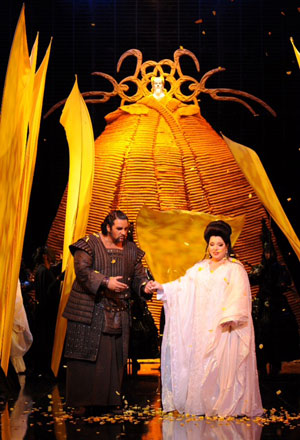
 Left – Rosario La Spina and Susan Foster. Cover – Opera Australia's 'Turandot'. Photos – Branco Gaica
This Turandot is as good as it gets. A fabulous production directed and choreographed by Graeme Murphy, a great cast headed by Australia's answer to Pavarotti, Rosario la Spina, and passionate, committed conducting from the Estonian conductor Arno Volmer.
This is the first opera I have ever seen where the director was also the choreographer. Usually choreography in opera is restricted to dances of peasants or of very rich people, or set pieces of ballet; and even when dance is more integrated with the production, as when the dance company Legs on the Wall danced in Opera Australia's splendid production of the Magic Flute a few years ago, it serves as decorative and emotional comment. But that is worlds apart from what Murphy achieved in this beautiful production.
It is hard to describe the sheer theatrical power of his use of the chorus, especially in the first act. He made of them on stage what Puccini makes of them musically, giving the audience a visual equivalent of their intensely vibrant singing. And while some of the techniques he used seemed as simple as a Mexican wave, the effect was unbelievably thrilling. While I admire directors who address the intellect by questioning various aspects of the score in the so-called directors theatre, Murphy's direction was entirely different. It made the stage speak the same emotional language as the music.
All this was coordinated with the use of barely more than three colours – black for night (the opera happens almost entirely at night), red for blood, and white, the Chinese colour of death. The ubiquitous fans, far from seeming over-decorous, represented something at once arbitrary and ineluctable with their opening and closing, as when Turandot is revealed in Act I. There were also various insightful quotations to go with Puccini's quoting from Brunnhilde's magic sleep music when Turandot is "awakened" from her misanthropy, and his librettist quoting the riddle scene from Siegfried; such as the head of Turandot's previous suitor being brought in as the head of John the Baptist in Salome.
And then there's Rosario la Spina, in one of the many Italian opera roles (Calaf) that seem to have been written for him. It wasn't just Nessun dorma and the riddle scene; every phrase he sang vibrated with the plangent intensity we associate with Pavarotti. Jud Arthur gave the small role of Timur a depth and warmth that suited the King-Lear-like part, and the roles of Ping, Pang and Pong, played with mercifully little attempt at humour, were convincing and strong.
Turning to the women, both Susan Foster and Daria Masiero sang with technical mastery and emotional commitment. For my taste, however, they were somewhat too closely matched in sound, so that Foster's voice was too warm and rich for the icy Turandot, and Masiero's perhaps too powerful and commanding for the slave-girl Liu. Nevertheless, Masiero's Tu chi di gel sei cinta left nothing to be desired for expressive force, and when Turandot melts at the kiss of the foreigner Calaf, Foster's warmth came into its own.
The chorus was stunning. I thought it had reached a zenith with Peter Grimes a couple of years ago, but in Turandot they seemed even more striking, especially the male voices. What power!
At this point I can say that this opera has always set my teeth a little on edge, with its orientalist depiction of Turandot (read China) as completely inhumane until colonised by the Tartar (read Western) prince Calaf, and also its valediction to 19th century opera with the suicide of Liu. While this production simply accepted all that, the choreography translated its action into the world of the Arabian Nights where it was born, and gave us something at once coherent and magical. I hope we see many more collaborations between Opera Australia and Graeme Murphy.
Opera Australia presents
Turandot
Giacomo Puccini
Director Graeme Murphy
Venue: Opera Theatre | Sydney Opera House
Dates: 17 Jan – 19 March, 2012
Bookings: www.opera-australia.org.au | (02) 9318 8200
Sydney Reviews
Turandot | Opera Australia
- Details
- Nicholas Routley
Most read Sydney reviews
The Lark | Hey Dowling
Noni Hazlehurst brings Rose and The Lark to colourful and compelling life in this one-woman show.
Pride & Prejudice* (*sort of) | Neil Gooding Productions & Woodward Productions
This rollicking musical take on Jane Austen’s beloved novel is a side-splitting crowd pleaser.
Heartbreak Hotel | EBKM
Heartbreak Hotel invites its audience into an intimate portrait of the universal and isolating experience of heartbreak.
Current | Sydney Dance Company
While Bonachela’s work is, as always, dreamily lovely, for me the highlights were absolutely the three commissioned choreographers: Azzam Mohamed, Jenni Large and Raghav Handa.
The Gospel According to Paul – The Second Coming | Soft Tread Productions
The Gospel According to Paul is meticulously crafted entertainment. It’s uplifting without pulling any punches.
More from this author
The First Murder | Pinchgut Opera
In the care of Pinchgut Opera’s director, Erin Helyard, this music, formulaic as it indeed...Messa da Requiem | Queensland Ballet
Messa da Requiem was a quite stunning way to inaugurate the new auditorium.Ensemble Pygmalion | 2026 Adelaide Festival
There is no doubt that the three programs presented by the Ensemble Pygmalion were the sen...Mary said what she said | 2026 Adelaide Festival
Going from that show to Mary said what she said was like going from a Mozart piano concert...Marwood and Mustonen | 2026 Adelaide Festival
The whole work is a testament to Shostakovich’s constant battle with the thought police of...
The Gospel According to Paul is meticulously crafted entertainment. It’s uplifting without pulling any punches.

While Bonachela’s work is, as always, dreamily lovely, for me the highlights were absolutely the three commissioned choreographers: Azzam Mohamed, Jenni Large and Raghav Handa.